
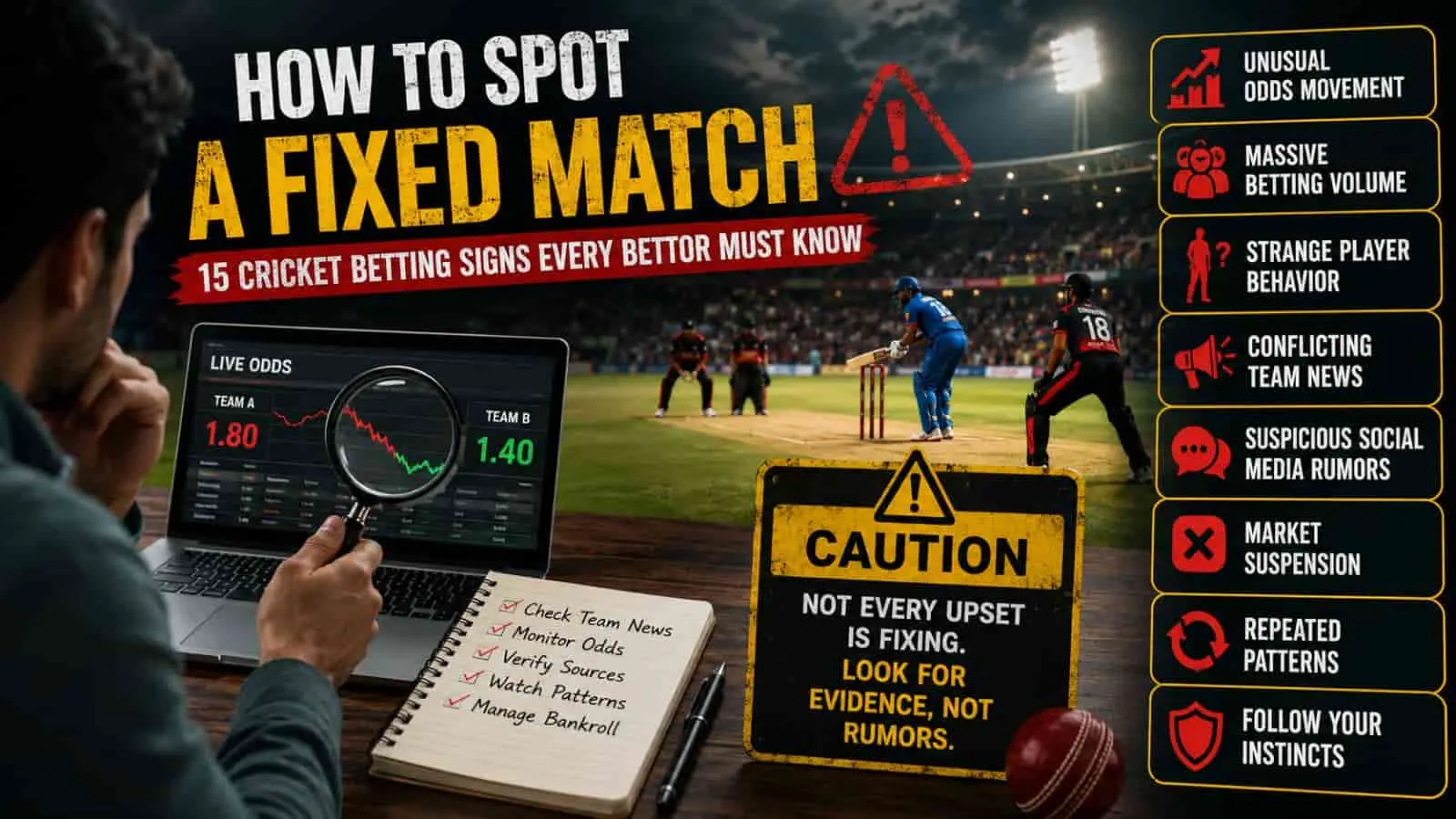
Every cricket bettor has experienced a match that simply didn’t feel right. A dropped catch at a crucial moment, an unnecessary run-out, strange captaincy decisions, or odds that suddenly shifted without any obvious reason can leave people wondering whether the match was fixed.
While genuine match-fixing does occur in sports from time to time, it is far less common than rumors on social media would suggest. Many unexpected results happen simply because cricket is an unpredictable game. Assuming every upset is a fixed match can lead to poor betting decisions and unnecessary losses.
The smarter approach is to understand the genuine warning signs that experienced bettors monitor before placing a wager. Learning to identify suspicious betting patterns, unusual market movements, questionable player behavior, and unreliable information sources can help you avoid risky bets and make better-informed decisions.
In this guide, you’ll learn the most common signs associated with potentially manipulated matches, how betting markets react, which rumors should be ignored, and how to protect your bankroll when something doesn’t look right.
What Is Match Fixing in Cricket?
Match-fixing refers to any deliberate attempt to manipulate the outcome or specific events in a cricket match for financial gain or other illegal benefits.
This may involve:
- Deliberately losing a match
- Spot-fixing specific events
- Manipulating overs
- Intentionally bowling no-balls
- Slow scoring during certain periods
- Deliberate fielding mistakes
- Planned dismissals
It’s important to understand that not every poor performance indicates fixing. Cricket involves pressure, mistakes, changing conditions, and unpredictable outcomes.
Professional bettors avoid making emotional assumptions and instead rely on evidence.
Why Bettors Should Learn to Spot Suspicious Matches
Recognizing warning signs helps you:
- Avoid placing money on questionable matches
- Reduce emotional betting
- Ignore misleading social media rumors
- Protect your betting bankroll
- Focus on more transparent markets
- Make decisions based on information rather than speculation
Many experienced bettors follow one simple rule:
If something doesn’t feel right and you cannot explain why, skipping the match is often the smartest bet.
Over the years, many people have shared their experiences with me. Still, one conversation about cricket betting has stayed in my mind because it showed how quickly assumptions can lead to costly decisions.
The person told me he had been following a domestic T20 tournament and considered himself a fairly careful bettor. He wasn’t someone who chased every match or believed every prediction on social media. But during one particular game, things started to feel strange. A simple catch was dropped in the powerplay, a batter attempted an unnecessary run that resulted in an easy run-out, and the betting odds shifted noticeably within a short period. The match chat on social media exploded with comments claiming, “This game is fixed.”
He admitted that after reading dozens of similar posts, he became convinced something suspicious was happening. Without doing much research, he increased his stake because he believed the rumors gave him an advantage. “I thought everyone else had insider information,” he told me. “I didn’t want to miss the opportunity.”
The result didn’t go the way he expected. The team he backed lost, and after the match, there was no official report of any wrongdoing. Later, he discovered that one of the team’s key bowlers had picked up a minor injury during warm-ups, which explained some of the unusual betting market movement. The dropped catch and poor run-out? They turned out to be nothing more than mistakes that happen in cricket every season.
What frustrated him most wasn’t losing the money—it was realizing that he had let online rumors influence his decision instead of relying on facts. He said the experience completely changed how he approached betting. From that day onward, he stopped treating every unexpected moment as evidence of match-fixing. Instead, he began checking official team news, comparing odds across different platforms, and asking a simple question before placing a bet: Is there real evidence, or am I reacting to speculation?
That conversation reminded me of something many experienced bettors eventually learn. Cricket is an unpredictable sport. A surprising batting collapse, a dropped catch, or sudden odds movement does not automatically mean a match has been manipulated. Sometimes there is a perfectly reasonable explanation, and sometimes there isn’t—but guessing can be expensive.
If you’re new to cricket betting, understanding the difference between genuine warning signs and ordinary moments in the game can save you from making emotional decisions. In the sections ahead, we’ll look at the most common signs that experienced bettors pay attention to, explain what they actually mean, and help you separate facts from rumors before placing your next bet.
15 Warning Signs That May Indicate a Suspicious Cricket Match
1. Unusual Betting Odds Movement
One of the strongest warning signs is sudden movement in betting odds without any official news.
For example:
- Team A opens at 1.80
- Within minutes it moves to 1.40
- No injuries announced
- No weather changes
- No squad updates
Large unexplained movements may indicate informed betting activity.
However, odds also move because of:
- High betting volume
- Market correction
- Expert opinion
- Late team announcements
Always look for an explanation before assuming manipulation.
2. Massive Betting Volume on Lower-Level Matches
Professional betting markets closely monitor international cricket.
Lower-level competitions sometimes receive unusually high betting activity despite limited public interest.
Examples include:
- Local T20 leagues
- Minor domestic tournaments
- Exhibition matches
- Club competitions
If betting volume appears unusually high compared to expected interest, many experienced bettors become more cautious.
3. Strange Player Decisions
Occasionally, players make decisions that seem completely out of character.
Examples include:
- Easy catches dropped repeatedly
- Reckless run-outs
- Defensive batting with plenty of wickets remaining
- Unnecessary risky shots
- Poor field placements
One mistake proves nothing.
Multiple unusual incidents within the same match deserve closer attention.
4. Unexpected Team Selection
Sometimes key players are left out without clear explanation.
Reasons may include:
- Rest
- Injury
- Rotation
- Team strategy
However, if several important players are suddenly unavailable with no official clarification, bettors often wait before entering the market.
5. Conflicting Team News
Reliable betting decisions depend on verified information.
Avoid relying on:
- WhatsApp forwards
- Telegram rumors
- Anonymous Twitter posts
- Fake insider tips
Always compare information with official announcements before making decisions.
6. Suspicious Social Media “Sure Shot” Predictions
Every major tournament attracts accounts claiming:
- 100% fixed match
- Confirmed insider information
- Guaranteed winner
- VIP prediction
- No-loss betting tips
Almost all of these are designed to sell subscriptions or generate engagement.
There is no legitimate source that can consistently predict fixed matches.
7. Unusual Spot Betting Patterns
Modern betting markets allow wagers on events such as:
- First over runs
- Number of wides
- Next wicket
- First boundary
- First six
- Individual overs
Large betting spikes on niche markets sometimes receive additional scrutiny from bookmakers and regulators.
8. Repeated No-Balls or Wides at Critical Moments
One accidental no-ball is normal.
Several unusual extras during highly significant moments may raise questions.
Historically, some spot-fixing investigations involved deliberate no-balls.
Still, bettors should avoid jumping to conclusions without official investigations.
9. Odds Move Before Official Announcements
If betting odds shift significantly before:
- Team announcements
- Toss
- Injury reports
Some bettors become cautious because information may already be circulating among certain market participants.
10. Unexplained Collapse by a Dominant Team
Every cricket fan has witnessed unbelievable collapses.
Sometimes they’re simply part of sport.
Other times bettors ask questions when:
- Batters play unusually reckless shots
- Multiple experienced players fail similarly
- The collapse appears completely unexpected
One collapse alone never confirms fixing.
11. Repeated Similar Patterns Across Matches
Patterns matter more than isolated incidents.
For example:
- Same players involved repeatedly
- Same unusual overs
- Similar betting market reactions
- Recurring suspicious events
Regulatory authorities investigate long-term patterns rather than isolated moments.
12. Lack of Official Match Coverage
Matches with limited:
- Broadcasting
- Live scoring
- Media attention
- Independent reporting
can sometimes be harder to verify.
Many experienced bettors avoid placing large wagers on competitions with poor transparency.
13. Betting Markets Suddenly Close
Bookmakers occasionally suspend betting because of:
- Weather
- Technical issues
- Team news
- Regulatory concerns
- Suspicious market activity
Market suspension alone does not mean fixing, but it may justify waiting for further information.
14. Official Investigations
If cricket governing bodies announce investigations before or after a match, bettors should stay informed through official sources rather than rumors.
Investigations are based on evidence—not speculation.
15. Your Instinct Tells You to Wait
Experienced bettors understand that skipping a match is often the best decision.
If several warning signs appear together:
- Strange odds
- Rumors
- Unusual team news
- Poor transparency
Waiting may be the smartest strategy.
There will always be another match.
Warning Signs vs Normal Cricket Events
| Situation | Usually Normal | Worth Watching |
| One dropped catch | ✅ | |
| Multiple easy catches dropped | ✅ | |
| Minor odds movement | ✅ | |
| Huge unexplained odds movement | ✅ | |
| One batting collapse | ✅ | |
| Repeated strange collapses | ✅ | |
| One no-ball | ✅ | |
| Several unusual no-balls in key moments | ✅ | |
| Injury announcement | ✅ | |
| Unknown player missing without explanation | ✅ | |
| Market suspension during rain | ✅ | |
| Market suspension with unusual betting activity | ✅ |
Common Myths About Fixed Matches
Myth 1: Every Unexpected Result Is Fixed
False.
Upsets happen regularly in cricket.
Even the strongest teams lose.
Myth 2: Telegram Channels Know Fixed Matches
False.
Most “fixed match” groups are marketing scams.
They earn money through paid memberships rather than accurate predictions.
Myth 3: Insider Information Is Always Reliable
False.
Many insider claims are fabricated.
Always verify information from official cricket boards, tournament organizers, or reputable sports media.
Myth 4: Odds Movement Always Means Fixing
False.
Odds change because of:
- Betting volume
- Injuries
- Toss
- Weather
- Team announcements
- Professional betting activity
How to Protect Yourself
Use this checklist before betting.
✔ Check Official Team News
Verify lineups from trusted sources.
✔ Monitor Odds
Look for logical explanations behind movement.
✔ Ignore Guaranteed Tips
No prediction is ever guaranteed.
✔ Research the Tournament
Established competitions usually have stronger monitoring systems.
✔ Avoid Emotional Decisions
Never chase suspicious opportunities.
✔ Manage Your Bankroll
Only risk money you can comfortably afford to lose.
Example Scenario
Imagine a domestic T20 match where:
- Odds suddenly shift dramatically two hours before the toss.
- Social media begins circulating “100% fixed match” messages.
- A key player is unexpectedly missing with no official explanation.
- Betting markets are briefly suspended.
None of these factors alone proves match fixing.
However, together they suggest caution. Instead of trying to exploit the uncertainty, a disciplined bettor may simply skip the match and wait for clearer opportunities. Avoiding questionable situations is often more profitable than chasing rumors.
Best Practices for Responsible Cricket Betting
Experienced bettors focus on:
- Reliable information
- Long-term strategy
- Consistent bankroll management
- Verified statistics
- Official news sources
- Discipline over emotion
The goal isn’t to identify every suspicious match—it’s to avoid unnecessary risk.
Frequently Asked Questions
Can ordinary bettors identify a fixed match?
Not with certainty. Bettors can only observe warning signs and unusual market behavior. Only official investigations can determine whether match fixing has occurred.
Does sudden odds movement always indicate fixing?
No. Odds move for many legitimate reasons, including injuries, toss results, weather conditions, betting volume, and updated team information.
Should I bet if I suspect a match is fixed?
No. If multiple warning signs create uncertainty, avoiding the match is generally the safer decision.
Are Telegram fixed match tips trustworthy?
Most are not. Many such channels make unsupported claims to attract subscribers or sell paid tip services.
Which cricket matches are generally more transparent?
Major international tournaments and well-regulated professional leagues typically have greater oversight, extensive media coverage, and integrity monitoring than smaller or unofficial competitions.
Learning how to spot potential warning signs of a suspicious cricket match is less about uncovering hidden conspiracies and more about becoming a disciplined, informed bettor. Sudden odds movements, unexplained team changes, unusual betting activity, and unverified rumors should encourage caution—not assumptions.
Remember that even when several warning signs appear, they do not prove a match has been fixed. Only official investigations by cricket authorities can establish wrongdoing. As a bettor, your best strategy is to rely on verified information, avoid rumor-driven decisions, manage your bankroll responsibly, and skip matches that raise unanswered questions.
If you’re looking to enjoy cricket betting responsibly, begin with a reliable online cricket ID from the Fairplay Cricket ID Provider homepage and explore the platform’s educational guides on betting basics, payment methods, bankroll management, and safe betting practices before placing your next wager.