
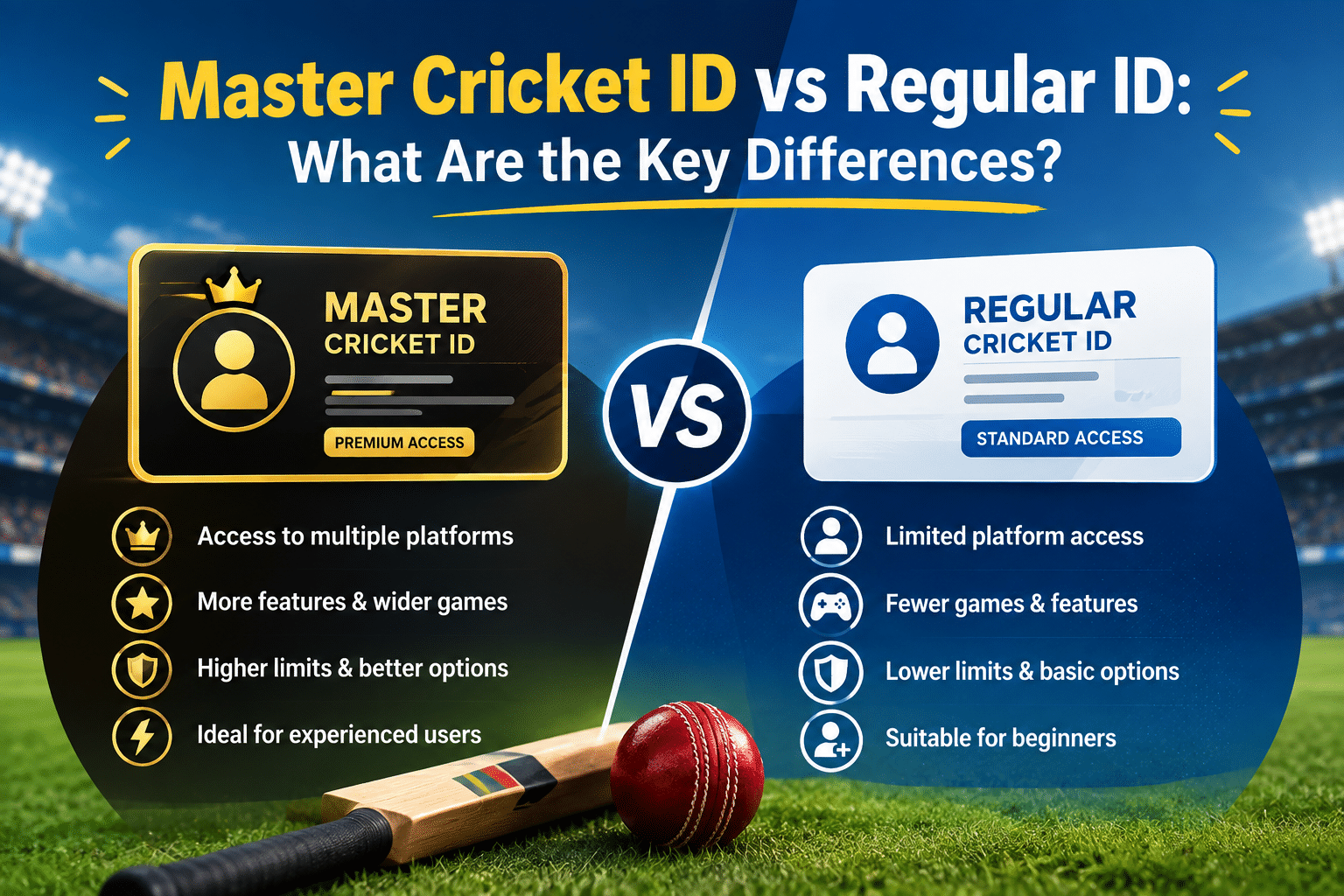
If you have come across the term master cricket ID while researching online cricket IDs, you may have wondered whether it is simply a better version of a regular ID. Understanding master cricket id vs regular id requires looking at the actual account structure instead of assuming that the word “master” means more benefits.
The answer is not that simple.
In the online cricket and betting industry, “master ID” is not a universally standardized technical term. Different platforms and providers can use it to describe different types of accounts, permissions, or account-management arrangements. In some environments, a master account can have broader administrative or account-management capabilities than an ordinary user account. In others, the term may simply be used as a marketing label.
That distinction matters.
A person researching master cricket id vs regular id should not assume that “master” automatically means higher limits, better odds, guaranteed withdrawals, greater security, or better returns. Those features depend on the underlying platform and its account structure.
Fairplay Cricket ID Provider presents its service around online cricket IDs, online betting IDs, fantasy sports IDs and related cricket services, while its site also separates pages such as its general Cricket ID Provider, Online Betting ID and Trusted Cricket ID Provider resources.
This guide explains the terminology clearly so you can understand what someone means when they offer or mention a master cricket ID.
Master Cricket ID vs Regular ID What Is the Difference?
When comparing master cricket id vs regular id, the biggest difference is usually the level of access and control, not the name printed on the account.
| Feature | Regular Cricket ID | Master Cricket ID |
| Intended user | Individual customer | Potentially an administrator, agent, or higher-level account |
| Basic login access | Usually yes | Usually yes |
| Personal account functions | Usually | Usually |
| Account-management permissions | Limited | May be broader |
| Ability to manage linked accounts | Usually unavailable | May be available |
| Administrative functions | Limited or none | May be available |
| Reporting tools | Depends on platform | May include additional reporting |
| Higher limits | Not automatically | Not automatically |
| Better odds | Not automatically | Not automatically |
| Guaranteed withdrawals | No | No |
| Greater security | Not automatically | Not automatically |
| Meaning across platforms | Relatively straightforward | Varies considerably |
The table highlights the most important point: a master ID is not automatically superior simply because it contains the word “master.”
The actual difference depends on the platform’s account hierarchy, permissions, terms and operating rules.
What Is a Master Cricket ID?
A master cricket ID generally refers to an account that has broader access, control, or account-management functionality than a standard user ID.
However, there is an important qualification: there is no single industry-wide definition of “master cricket ID.”
Depending on the platform, a master account may be associated with:
- Account administration
- Management of linked or subordinate accounts
- Different account permissions
- Access to additional platform functions
- Agent or operator-level features
- Different reporting or account-management tools
In a normal consumer environment, a regular cricket ID is generally intended for one individual user. A master account, where the platform actually supports such a structure, may sit at a different level within the platform’s account hierarchy.
Therefore, the first question should not be:
“Is a master ID better?”
It should be:
“What additional permissions or functions does this particular platform actually give to a master ID?”
That approach makes it easier to understand the real difference between a master account and an ordinary cricket account.
What Is a Regular Cricket ID?
A regular cricket ID generally refers to a standard user account created to access the features available to an ordinary customer.
Depending on the platform, a regular ID may provide access to cricket-related services, sports markets, account information, transaction functionality, or other features.
Fairplay’s own Online Cricket ID material describes an account-registration process involving the website and WhatsApp support, while its broader site structure includes separate resources for online betting IDs, fantasy sport IDs and cricket ID services.
The important point is that a regular ID is normally designed around individual user access, rather than administration of other accounts.
For an individual who only needs access to the features provided to normal customers, a regular cricket ID may be sufficient.
What a User Shared With Me About His Master Cricket ID Experience?
During a recent trip, I ended up having a conversation with someone sitting nearby while we were discussing cricket. At one point, the discussion moved toward online cricket platforms, and he mentioned his recent experience with a Master Cricket ID. Since I was researching the topic, I asked him to explain what happened from the beginning.
He told me that, initially, he did not understand what made a Master Cricket ID different from a regular cricket ID. He had seen people using the term “master” as if it automatically meant a better or more powerful account. Like many users, he assumed it might come with higher limits, better access, or some special advantage.
“But I later realised that the word master itself doesn’t tell you much,” he explained.
His interest started when someone introduced him to a cricket platform and mentioned that there were different types of accounts. He was already familiar with a normal cricket ID, which he understood as an individual account used to access the available cricket-related services. The idea of a Master ID was new to him.
When he asked about it, he was told that a master-level account could have broader account-management or administrative functions. That made him curious, but it also raised more questions.
He wanted to know whether a Master ID was simply an upgraded version of a regular account.
After looking into it, he found that there was no universal industry definition of “Master Cricket ID.” Different platforms can use the term differently. In some account structures, a master account may have additional permissions, linked-account management or reporting functions. In other cases, “master” may simply be a label used by a provider.
That was an important point for him.
He said that before this experience, he would probably have assumed that a Master ID automatically meant higher betting limits or better benefits. But once he understood how account structures can work, he became more careful about those assumptions.
He gave me an example.
“If someone tells me a Master ID gives unlimited betting or guaranteed benefits, I would want to know exactly where that comes from,” he said.
According to him, the most useful thing he learned was to ask about permissions rather than the name of the account. A genuine master account, where such a structure exists, might have access to linked accounts, reporting tools or other administrative functions that a regular customer account does not normally have.
He also discovered that a regular cricket ID could be perfectly adequate for someone who simply wants individual access to a cricket-related platform. There was no reason to choose a master-level account merely because it sounded more advanced.
What concerned him most was security.
He told me that an account with broader permissions could actually require more careful security management, rather than automatically being safer. He started paying attention to password security, authentication options, account recovery and who had access to the account. The guide similarly notes that greater permissions can increase the importance of proper security practices.
Before finishing our conversation, I asked him what he would tell someone who was being offered a Master Cricket ID for the first time.
His answer was simple: ask questions before accepting it.
He suggested finding out exactly what the account can do, whether it can manage other accounts, who owns it, what terms apply, what limits exist and which platform actually operates behind the account. The source material recommends the same approach—understand the permissions, account structure, ownership, terms and security controls before proceeding.
Looking back, he said the experience helped him stop judging an account by its name.
For him, the biggest lesson was that “master” does not automatically mean better. A regular ID may be sufficient for an individual user, while a master-level account can make sense only when its additional functions are genuinely required.
As our conversation ended, he summed up his experience in one sentence:
“I don’t ask whether it’s a Master ID anymore. I ask what the account actually lets me do.”
That seemed like the most practical takeaway from his experience—and probably the most useful point for anyone trying to understand the difference between a Master Cricket ID and a regular one.
A Realistic Experience With a Master Cricket ID
During a recent trip, I ended up having a conversation with someone sitting nearby while we were discussing cricket. At one point, the discussion moved toward online cricket platforms, and he mentioned his recent experience with a Master Cricket ID.
Since I was researching the topic, I asked him to explain what happened from the beginning.
He told me that, initially, he did not understand what made a Master Cricket ID different from a regular cricket ID. He had seen people using the term “master” as if it automatically meant a better or more powerful account.
Like many users, he assumed it might come with higher limits, better access, or some special advantage.
“But I later realised that the word master itself doesn’t tell you much,” he explained.
His interest started when someone introduced him to a cricket platform and mentioned that there were different types of accounts. He was already familiar with a normal cricket ID, which he understood as an individual account used to access the available cricket-related services.
The idea of a Master ID was new to him.
When he asked about it, he was told that a master-level account could have broader account-management or administrative functions. That made him curious, but it also raised more questions.
He wanted to know whether a Master ID was simply an upgraded version of a regular account.
After looking into it, he found that there was no universal industry definition of “Master Cricket ID.” Different platforms can use the term differently. In some account structures, a master account may have additional permissions, linked-account management or reporting functions. In other cases, “master” may simply be a label used by a provider.
That was an important point for him.
Before this experience, he said he would probably have assumed that a Master ID automatically meant higher betting limits or better benefits. But once he understood how account structures can work, he became more careful about those assumptions.
He gave me an example.
“If someone tells me a Master ID gives unlimited betting or guaranteed benefits, I would want to know exactly where that comes from,” he said.
According to him, the most useful thing he learned was to ask about permissions rather than the name of the account.
A genuine master account, where such a structure exists, might have access to linked accounts, reporting tools or other administrative functions that a regular customer account does not normally have.
He also discovered that a regular cricket ID could be perfectly adequate for someone who simply wants individual access to a cricket-related platform. There was no reason to choose a master-level account merely because it sounded more advanced.
What concerned him most was security.
He told me that an account with broader permissions could actually require more careful security management, rather than automatically being safer.
He started paying attention to password security, authentication options, account recovery and who had access to the account.
Before finishing our conversation, I asked him what he would tell someone who was being offered a Master Cricket ID for the first time.
His answer was simple:
Ask questions before accepting it.
He suggested finding out exactly what the account can do, whether it can manage other accounts, who owns it, what terms apply, what limits exist and which platform actually operates behind the account.
Looking back, he said the experience helped him stop judging an account by its name.
For him, the biggest lesson was that “master” does not automatically mean better.
A regular ID may be sufficient for an individual user, while a master-level account can make sense only when its additional functions are genuinely required.
As our conversation ended, he summed up his experience in one sentence:
“I don’t ask whether it’s a Master ID anymore. I ask what the account actually lets me do.”
That is a practical way to understand the difference between a master cricket ID and a regular ID.
Why Do Platforms Use Master IDs?
Platforms that use account hierarchies may need different levels of access.
Imagine a platform with hundreds or thousands of accounts. Giving every account identical administrative permissions would create obvious security and management problems.
Instead, the platform may create different account levels.
A simplified structure could look like this:
Platform
↓
Master Account
↓
Sub-account or Agent Account
↓
Regular Customer Account
This is only an illustrative structure. Not every cricket platform uses it, and the terminology can vary.
A master account might therefore exist because the platform needs a way to organize accounts, permissions, reporting, or other administrative functions.
That is very different from saying that a master ID is simply a “premium customer ID.”
Understanding this distinction is important when comparing different types of cricket accounts.
Does a Master Cricket ID Give Higher Betting Limits?
Not necessarily.
This is one of the most common assumptions surrounding master IDs.
Some providers may market master accounts using language associated with higher limits or broader access. But the word master itself does not establish that a particular account has a higher limit.
Account limits can depend on factors such as:
- Platform rules
- Account type
- Verification status
- Risk controls
- Market availability
- Applicable jurisdiction
- Transaction history
- Platform-specific policies
If somebody tells you that a master ID automatically provides “unlimited betting,” ask for the actual terms rather than relying on the label.
A legitimate account structure should be explainable.
Users should also avoid treating account labels as promises of financial results. Betting involves risk, and an account type does not remove that risk.
Is a Master ID the Same as a Premium Cricket ID?
No.
The two concepts can overlap in marketing, but they are not inherently the same.
A premium ID generally describes an account marketed as offering additional benefits or features.
A master ID generally describes an account based on a particular permission or account hierarchy.
For example, a platform could technically have:
- Regular user account
- Premium user account
- Master administrative account
Those three account types could have completely different purposes.
Therefore, never assume that “master,” “premium,” “VIP,” or “high-limit” means the same thing.
The platform should clearly explain the function and permissions attached to each account level.
Master ID vs Regular ID A Practical Example
Suppose two people are given cricket IDs.
Person A receives a regular user ID. They can log into their account, access the services available to ordinary users, view their account activity, and manage their own account according to the platform’s rules.
Person B is offered a master ID.
Instead of immediately assuming Person B has a better account, the correct question is what the platform means by “master.”
If the master account has administrative functionality, it may allow Person B to manage linked accounts or access reporting tools.
If the provider simply uses “master” as a promotional label but gives no additional functionality, there may be little meaningful difference.
This is why the actual permissions matter more than the terminology.
What Features Might a Master Account Have?
Where a genuine account hierarchy exists, a master-level account may have features such as:
Account Management
The account may have permission to view or manage connected accounts.
Reporting
A master account may have access to broader reports than an ordinary customer account.
Account Hierarchy
The platform may allow master accounts to sit above subordinate or linked accounts.
Administrative Controls
Some systems may provide additional configuration or management functions.
Broader Platform Access
Depending on the software architecture, the account may access sections unavailable to ordinary customers.
None of these features should be assumed without confirmation from the platform.
A provider should explain exactly which functions are available rather than relying on the account name.
What Does a Regular Cricket ID Usually Do?
A regular account is generally much simpler.
The user logs into their own account and accesses the services made available to that account.
Typical functionality can include:
- Login and account authentication
- Personal profile management
- Viewing available cricket or sports services
- Reviewing account activity
- Using available platform features
- Contacting customer support
- Managing permitted account transactions
The exact functionality varies by provider.
Fairplay’s website describes its online cricket ID process as beginning through its website and continuing through WhatsApp-based assistance, while its service structure separately lists Online Betting ID and Fantasy Sport ID offerings.
For users who only need personal access, a standard account may provide everything they require.
Is a Master Cricket ID More Secure?
Not automatically.
Security comes from the platform’s technical controls, authentication practices, account permissions, privacy policies and operational procedures.
In fact, an account with more permissions can require more careful security management because unauthorized access could potentially affect more functions.
Anyone using an account with elevated permissions should therefore pay particular attention to:
- Strong, unique passwords
- Two-factor authentication where available
- Secure devices
- Login alerts
- Session management
- Avoiding credential sharing
- Verifying support requests
- Reviewing account permissions
Do not treat “master” as a synonym for “secure.”
A secure account depends on the controls provided by the platform and the way the user manages access.
Can a Regular User Upgrade to a Master ID?
That depends entirely on the platform.
Some systems may allow account upgrades. Others may reserve master accounts for administrators, agents, partners, or specific business relationships.
If somebody offers to “upgrade” your account, ask:
- What exactly changes?
- What additional permissions are provided?
- Is the account still a personal account?
- Are there new terms and conditions?
- Are there additional verification requirements?
- Who controls the account?
- Can the account be downgraded later?
A genuine upgrade should be clearly explainable without relying on vague promises.
Does a Master ID Mean You Can Manage Other Users?
Possibly, but not universally.
This is one of the defining characteristics of some master-account systems.
A platform may allow a master account to manage subordinate accounts, but that does not mean every account advertised as a “master cricket ID” has those capabilities.
If another person claims that your master ID allows you to create or control other accounts, ask the provider to explain the account hierarchy and permissions in writing.
Never rely solely on a WhatsApp message or verbal explanation when the account has significant administrative privileges.
Master Cricket ID vs Agent ID
Another common source of confusion is the difference between a master ID and an agent ID.
They can be related but are not necessarily identical.
An agent account may be designed for a person who operates within a platform’s distribution or customer-management structure.
A master account may sit above one or more account levels.
A simplified example might be:
| Account | Possible Purpose |
| Regular ID | Individual customer access |
| Agent ID | Customer or account-management role |
| Master ID | Higher-level account-management role |
| Platform/Admin | Full system administration |
This is only a conceptual example. Actual structures vary between platforms.
The safest approach is to ask the provider for the actual account hierarchy rather than assuming that an agent and master account have identical permissions.
Warning Signs When Someone Offers a Master Cricket ID
The term itself is not evidence that an offer is legitimate.
Be cautious when someone claims that a master ID provides:
- Guaranteed profits
- Unlimited withdrawals
- Guaranteed winning rates
- Completely risk-free betting
- Secret access to fixed matches
- Guaranteed premium odds
- Guaranteed account approval
- Unlimited credit without documented terms
These claims are very different from legitimate explanations of account permissions.
A professional provider should be able to tell you what the account does, not merely promise what you will supposedly earn from it.
Fairplay’s site itself includes responsible-betting language stating that betting should be treated as entertainment rather than an income source.
Users should also check the laws and regulations that apply in their own location before using any betting-related service.
How to Verify What a Master ID Actually Means?
Before accepting a master account, use a simple verification process.
1. Ask for the Exact Definition
Ask the provider:
“What additional permissions does the master ID have compared with a regular ID?”
The answer should be specific.
2. Ask for the Account Structure
If the provider says the master ID can manage other accounts, ask how that hierarchy works.
3. Request the Terms
Read the applicable account terms before agreeing to anything.
4. Check the Underlying Platform
Do not evaluate the intermediary alone. Identify the actual platform connected to the account.
5. Verify Account Ownership
Understand whose name the account is registered under and who ultimately controls it.
6. Check Security Controls
Find out what authentication and recovery options are available.
7. Do Not Share Sensitive Credentials
A provider should never need your password simply to “verify” that you have a master ID.
These steps can help users understand whether the account being offered matches the description they received.
Master Cricket ID Checklist
Before using any account described as a master ID, check the following:
- The provider clearly explains what “master” means.
- The account’s permissions are documented.
- You know whether it is a personal, agent, or administrative account.
- The underlying platform is identifiable.
- Account ownership is clear.
- Terms and conditions are available.
- Security and recovery procedures are explained.
- Any fees or limits are disclosed.
- No guaranteed-profit claims are being made.
- You are not being pressured to transfer money immediately.
- You understand the rules applicable to your location.
This checklist is useful because it shifts attention from marketing language to practical account details.
How Fairplay’s Cricket ID Structure Should Be Evaluated?
Fairplay Cricket ID Provider currently organizes its website around several related services, including Online Betting ID, Fantasy Sport ID, Online Cricket ID, Cricket Pay and cricket ID provider resources.
Its dedicated Cricket ID Provider page describes the ID concept around registration, platform access, security, compatibility and account-related functionality.
However, the site does not establish a universal industry definition of “master cricket ID.”
Therefore, if a particular Fairplay-related offer uses the term master ID, the exact permissions and account structure should be confirmed directly rather than inferred from the word “master.”
That distinction keeps the terminology clear and prevents users from confusing an account label with a guaranteed set of benefits.
Is a Master Cricket ID Better Than a Regular ID?
There is no universal answer.
If your only requirement is accessing a cricket-related platform as an individual user, a regular ID may be all you need.
If a platform genuinely provides a master account with additional administrative or account-management functions, those features may be relevant to a particular business or operational use.
The right account is therefore determined by what you need the account to do, not by which name sounds more advanced.
This is also the main lesson from the experience shared earlier. Instead of asking whether a Master ID sounds better, users should ask what additional functions it provides and whether those functions are actually needed.
Key Takeaways From Master Cricket ID vs Regular ID
The difference between these account types can be summarized in a few simple points:
- A regular cricket ID is generally designed for individual users.
- A master cricket ID may have broader account-management permissions.
- “Master ID” does not have one universal industry definition.
- A master account does not automatically mean higher limits.
- A master account does not guarantee better odds or financial results.
- Master and premium accounts are not necessarily the same.
- Master and agent accounts can have different purposes.
- Greater account permissions can create greater security responsibilities.
- Users should verify ownership, terms, permissions and account structure.
- The actual functionality matters more than the account label.
The most useful lesson is simple: understand the account before using it.
About Master Cricket Id vs Regular Id
What is a master cricket ID?
A master cricket ID generally refers to an account with broader permissions or account-management capabilities than a standard user ID. However, “master ID” is not a standardized industry term, so its exact meaning varies by platform.
What is a regular cricket ID?
A regular cricket ID is generally a standard user account intended for individual access to a cricket-related online service.
Is a master cricket ID better than a regular ID?
Not necessarily. A master ID may provide additional administrative features, but those features may not be useful to an ordinary user. The account’s actual permissions matter more than its name.
Does a master ID guarantee higher betting limits?
No. The term “master” does not automatically guarantee higher limits. Limits depend on the specific platform, account rules, verification status and other applicable conditions.
Does a master ID mean unlimited betting?
No. “Master ID” should not be interpreted as unlimited betting access. Any limits must be confirmed through the platform’s actual terms.
Can a master cricket ID manage other accounts?
Some account hierarchies allow master-level accounts to manage subordinate accounts, but this is platform-specific and should never be assumed.
Is a master ID the same as an agent ID?
No. A master ID and agent ID can have different permissions and purposes, although some platforms may place them within the same account hierarchy.
Is a master cricket ID safer than a regular ID?
Not automatically. Security depends on authentication, account controls, platform security and how the credentials are handled.
Can anyone get a master cricket ID?
Not necessarily. Some platforms may restrict master accounts to particular users, agents, partners or administrators.
What should I ask before accepting a master cricket ID?
Ask what permissions it provides, who owns the account, whether other accounts can be managed, what limits apply, what terms govern the account and what security controls are available.
Does a master cricket ID guarantee profits?
No. An account type cannot guarantee profits or winning results. Users should be cautious about any provider making guaranteed-return claims.
How is a master cricket ID different from a regular cricket ID?
The main potential difference is account permission. A regular ID is generally intended for individual access, while a master account may provide additional management, reporting or administrative functions depending on the platform.
Conclusion
The key to understanding master cricket id vs regular id is to look beyond the terminology.
A regular cricket ID is generally an individual user account. A master ID, where a platform actually supports the concept, may provide broader permissions, account-management capabilities or access to a higher level of an account hierarchy.
But master does not automatically mean better.
It does not by itself guarantee higher limits, better odds, faster withdrawals, greater security or financial benefits. Those claims need to be supported by the actual platform rules.
The experience shared in this article reinforces the same point. A person who initially believed that “master” meant a more powerful or beneficial account eventually realized that the account’s actual permissions were much more important than its name.
If you are researching an online cricket account, start with the provider’s explanation of the service and understand exactly what type of ID you are being offered.
Fairplay Cricket ID Provider maintains separate resources for its [Cricket ID Provider], Trusted Cricket ID Provider, Best Cricket ID Provider, IPL Cricket ID Provider and Online Betting ID services, which can be useful when comparing the terminology used across its site.
Ultimately, the most useful question is not:
“Is this a master ID?”
It is:
“What exactly can this account do, who controls it, and what rules apply to it?”
That question provides a much clearer way to evaluate a master cricket ID compared with a regular cricket ID.